

On 30 June 2026, my year as President of the Rotary Club of Eldoret-Uasin Gishu officially came to an end.
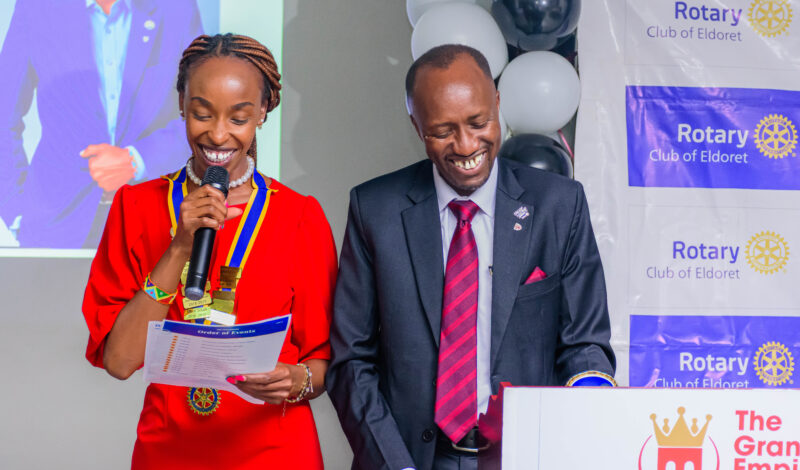
But somehow, the year did not feel completely over until Saturday, 8 August, when I formally handed over the presidency to my colleague in service, Rtn. Kimani Njoroge.
Perhaps that is because leadership is not really about the date on which an appointment ends.
It is about the flow, reality and alignment of the stewards themselves.
And as I look back at the year, I realise that the greatest thing Rotary gave me was not another list of things I have done.
It gave me a different understanding of leadership.
I entered the year with knowledge to serve.
I leave it understanding much more about stewardship.
A year that moved very quickly
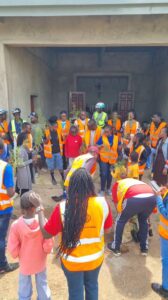
Twelve months moved at lightning speed. Perhaps it was the sheer flurry of activities that filled the Rotary year 2025/2026.
We increased our membership.
We moved our club from being a non-giving club to a giving club, and I am especially humbled and proud to note that every new member who joined during my year contributed to The Rotary Foundation. That mattered to me because I came to understand that giving is not simply about money. It is about cultivating a culture in which members see themselves as contributors to something larger than themselves.
We strengthened our relationship with Rotary partners who remained present and willing to work alongside us throughout the year.
We welcomed international visitors, each bringing a different story, perspective or opportunity for service.
We chartered the Interact Club of Nova Pioneer Boys (Eldoret) — a first in our region — because service must also be about preparing the next generation to lead.
We formalised our institution by registering the club as a society, drafted our Constitution and Bye-Laws, and strengthened our financial systems.
We became compliant and moved into a position where we can undertake District Grants, while continuing the work required to become Global Grant ready.
We welcomed two visits from the phenomenal Immediate Past District Governor Wairimu Njage during the year — one as part of the regular club and regional visit, during which we visited the Badilisha Maisha Centre at Outspan, and another when our club successfully hosted the North Rift Foundation Dinner.
We attended the District Conference Assembly — a memorable last dance of District 9212 before the emergence of the new Districts 9215 and 9216.
We also made space simply to be Rotarians together.
One of my favourite memories was our family gathering at Dr. Giblert Arap Bor‘s farm, where we explored his extraordinary farm and learned about four different ways of harnessing renewable energy and the environment to meet our everyday needs.
There were meetings, projects, celebrations, visitors, reports, plans, deadlines, WhatsApp messages, unexpected problems and the occasional moment when I wondered whether I had bitten off more than I could chew.
But the real work was underneath the activity
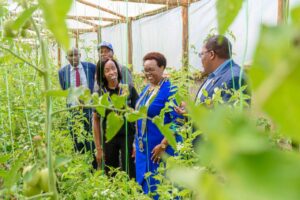
Tour at the Badilisha Maisha Center, Outspan Project
Looking back, I realise that I was not simply trying to make things happen.
I was trying to build something that could outlive my time in office.
That distinction changed me.
We worked from a three-year strategic plan, rather than allowing the year to be driven entirely by whatever happened to be urgent that week.
We developed an annual service calendar around Rotary’s monthly themes and activities.
We worked on governance, finances, membership, partnerships, systems, and cultivating a positive club culture.
And somewhere in all of that, I began to understand that leadership is less about being the person who does everything and more about creating the conditions in which other people can do meaningful things well.
Rebuilding
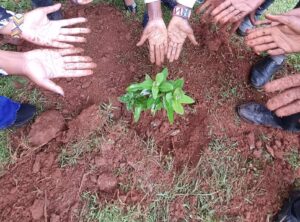
This became particularly meaningful to me because I entered my presidential year with a very deliberate responsibility: to rebuild.
Our Club needed stronger governance and financial stewardship. It needed to rebuild its standing and confidence within Rotary. It needed systems and discipline.
And rebuilding an institution taught me that leadership is rarely about one spectacular act.
It is about doing the small, sometimes invisible things that make it possible for someone else to succeed later.
I learned that the best leaders do not merely think about what they can accomplish during their own tenure.
They think about what they are leaving behind.
They ask:
Will the next person have to start again? Or will they be able to begin from where we stopped?
These questions have stayed with me.
And it has changed the way I think about leadership beyond Rotary.
At CELSIR, where my work is centred on institutional reform, empowerment and sustainable change, this lesson is particularly significant.
Institutions do not become sustainable because one person works very hard.
They become sustainable when systems outlive individuals.
They become sustainable when knowledge is shared rather than hoarded.
When leadership is developed rather than guarded.
When people are given room to grow.
When responsibility is transferred deliberately.
And when the person who comes after you is not seen as a threat to your legacy, but as the person who will carry it further.
The Troika: Leadership That Continues
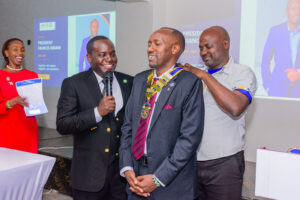
Current President Rtn. Kimani receiving the President’s chain
Power is transient.
Every office has an end.
Every title has an expiry date.
Every leadership role will, eventually, belong to someone else.
But perhaps the deeper lesson of leadership is not simply learning how to hand over power.
It is learning how to prepare the next person to carry the work forward.
Rotary has a beautiful model for this. It is what we call the Troika—a leadership approach that brings together three stages of leadership: the President-Elect, the sitting President, and the Immediate Past President.
The President provides leadership for the present.
The President-Elect prepares for the future.
And the Immediate Past President brings the experience and institutional memory and ethos of the past.
Three perspectives.
Three stages.
One continuous journey.
The idea is simple but powerful: the Club should never have to start again every time the President changes.
Instead, experience should inform the present, the present should prepare the future, and the future should carry the institution forward.
During my year as President of the Rotary Club of Eldoret–Uasin Gishu, I came to appreciate this model in a much deeper way.
I had the privilege of working alongside Rtn. Kimani Njoroge, who was not merely waiting in the wings for his turn at the presidency. He was already deeply immersed in the work.
He served as our Treasurer, New Generations Officer and the President-Elect.
He was present throughout the journey. At planning meetings, fundraisers, tree-planting activities, service projects, and community engagements. He was present on the long days and in the difficult conversations. He was there in the moments when plans worked and in moments when they did not.
He was not simply observing leadership. He was experiencing it. And that made the eventual transition profoundly different.
When the presidency changed hands on 8 August, it did not feel like one chapter had closed and another had begun from scratch.
I did not cease to be part of the journey. I moved into another place in the Troika—bringing with me the experience of the year, ready to support rather than direct, to advise rather than control, and to make room for new leadership.
That transition has reminded me of something I increasingly believe about leadership:
We are custodians, not owners.
We hold institutions for a while.
We strengthen what we can.
We repair what is broken.
We build and rebuild what is needed.
We prepare those who come after us.
And then we step aside.
Not because our contribution no longer matters, but because the institution matters more than any one of us and purpose must be permanent enough to survive the people who hold power.
Leadership is about being remembered as someone who helped make the institution stronger for the person who would sit in it next.
The leader changes.
The season changes.
The tools of power change hands.
But the work (service) must continue.
And if we have led well, it continues stronger because we were at the helm.
Lesson in Humility
Leadership is not about making yourself indispensable.
It is about making the institution less dependent on you.
And there is humility in that.
It requires us to accept that our season will end. That another voice will lead the meeting. That another set of ideas will shape the next chapter.
And that is not a diminishment of what we did.
It is evidence that the work was never supposed to be about us.
What Leadership Leaves Behind
Looking back, I am deeply grateful for the opportunity to have served alongside people who taught me this lesson in practice.
I am grateful for the profound lessons Rotary gave me, for the guidance of our District leaders—particularly Immediate Past District Governor Wairimu Njage—and for the wisdom shared along the way.
I am grateful for the Board that walked with me through the year, through both its triumphs and its challenges.
And I am grateful for the President-Elect who did not wait for tomorrow to begin serving, but walked alongside me throughout the journey, ready to carry the work forward.
And I am grateful for the experience of seeing leadership transition not as an ending, but as a continuation of purpose.
Somewhere along that journey, colleagues in service also became friends.
And that, too, is one of the gifts of leadership.
We begin by working together toward a purpose. We discover each other’s strengths. We navigate difficulties together. We celebrate victories together.
And, somewhere along the way, we realise that the relationships built in service may become some of the most enduring things we carry away from the experience.
Bitter Pill
Not every leadership lesson comes wrapped in a beautiful story.
Some arrive as a bitter pill.
And Rotary gave me a few.
One of the most important things I learned this year was something I thought I already understood:
How do you lead people who are not obliged to follow you?
That sounds simple until you actually have to do it.
Rotarians are volunteers. You do not employ them. You cannot put them on a performance improvement plan. You cannot withhold a salary because they did not attend the meeting. You cannot simply say, “Do this because I am the President.” You have to persuade. You have to listen. You have to negotiate. You have to accommodate. You have to inspire.
And sometimes, frankly, you have to take a very deep breath. 😂
It is a painful job.
But it is also one of the most valuable leadership laboratories I have ever experienced.
Because leading volunteers forces you to confront an uncomfortable truth:
Authority can make people comply. Influence makes people choose to participate.
And when people are giving you their time freely, your leadership cannot be built on authority alone.
You have to steward people. You have to understand their strengths. You have to understand their limitations. You have to know when to push, when to persuade, when to listen—and sometimes when to simply let something go.
I learned that you cannot lead volunteers as though they are employees.
They have their own lives, priorities, ideas, expectations of what Rotary should be, and occasionally, very strong opinions about how you are doing as President.
Which brings me to another bitter pill:
Criticism.
Leadership exposes you.
And sometimes the harshest criticism does not come from outside.
It comes from within.
I learned what it feels like to have your decisions questioned by the very people sitting around the Board table with you.
I learned that disagreement can become deeply personal when you are already carrying the weight of responsibility.
I learned that some people will believe you are moving too slowly.
Others will believe you are moving too fast.
Some will think you are doing too much.
Others will wonder why you are not doing more.
And sometimes, despite your best efforts, people will leave.
During my year, some Board members stepped away midway through the journey.
I would be dishonest if I said that did not affect me.
It did. It affected the work and momentum.
And, at times, it affected me personally.
But leadership does not give you the luxury of stopping simply because something hurts.
You grieve the disappointment. You adjust. You redistribute the work. You find your footing. And you continue.
That experience taught me something important about resilience:
Sometimes leadership is not about keeping everyone. It is about continuing to serve even when not everyone stays.
But perhaps the more subtle lesson was learning how to carry criticism with grace.
Not every criticism is an attack. Not every critic is an enemy.
Sometimes criticism reveals something you need to hear. Sometimes it reveals something about the person giving it. And sometimes it is simply the price of being the person who has to make decisions. The challenge is developing enough maturity to distinguish between the three.
That is a lesson I am still learning.
The Work Behind the Promise
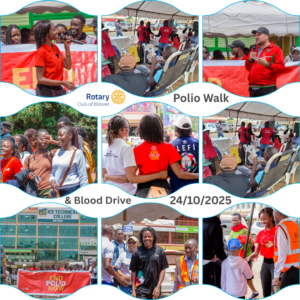
Polio Walk and Blood Donation Drive in October 2025 during Anne’s tenure
There was another side to this year that people rarely see.
I had to learn how to carry a Club that was rebuilding—and still inspire confidence in the people outside it.
When you are rebuilding an institution, you know what is happening behind the scenes.
You know which systems are still being fixed, which processes need strengthening, where the gaps are, and what still keeps you awake at night.
But your partners do not need to carry all of that anxiety.
They need to know that if you have said something will happen, you will do everything within your power to make it happen.
So I learned to carry the broken pieces quietly while presenting the possibility of what the Club could become.
That was not pretending.
It was leadership.
It meant going behind the scenes and doing the hard work necessary to make good on the confidence that others had placed in us.
Sometimes it meant making ten phone calls after a meeting. Sometimes it meant fixing something that nobody would ever know had been broken. Sometimes it meant finding another solution when the original one failed. Sometimes it meant saying, “Give us a little more time.”
And then working to ensure that when that time came, we delivered.
That taught me something that I will carry with me into CELSIR:
A leader must sometimes hold the anxiety so that the people they lead can hold the vision.
You cannot inspire confidence if you are constantly broadcasting panic. But neither can you inspire confidence by pretending that problems do not exist. The work is to acknowledge the brokenness, confront it honestly, and then build. Quietly, persistently, and faithfully.
The Advice We Sometimes Ignore
And then there is perhaps my most uncomfortable lesson.
The lesson of listening to those who came before us.
Before I formed my Board, I had conversations with people who had led the Club before me.
One of them cautioned me about a particular leadership choice.
The warning was not subtle. I heard it. I considered it. And then I made my own decision.
Looking back, I believe that was one of the decisions I most regret from my presidential year.
Not because I believe that another person should have made the decision for me.
But because I had been given institutional knowledge—information earned through someone else’s experience—and I did not give it the weight it deserved.
That has stayed with me.
Because sometimes we think leadership means making our own mistakes.
It does not.
Wisdom is also the ability to learn from somebody else’s mistakes. Listening to the wisdom of those who have served before you.
There is a dangerous form of independence in leadership that says:
“I will judge everything for myself.”
Of course we must think independently. Of course we must make our own assessments. But independence should not become arrogance. People who have walked the road before us sometimes see the pothole before we do. They may not always be right. But we would be foolish not to look where they are pointing.
That experience taught me to value institutional memory differently, more weightily, to ask more questions, to listen more intently, to seek context before making decisions, and perhaps most importantly, to understand that experience is an asset even when it comes in the form of an uncomfortable warning.
What the Bitter Pill Gave Me
I would not choose to repeat all the difficult experiences of this year.
But I am grateful for what they taught me.
They taught me that people are complicated; volunteers must be led differently from employees; criticism is inevitable; not everyone will remain with you throughout the journey; institutions can be fragile; rebuilding requires both courage and patience; promises create obligations; confidence must be earned; sometimes the hardest work is invisible; and the people who challenge us most can leave us with some of our most important lessons.
Perhaps that is why I now look at those difficult moments differently.
They were painful.
Some were deeply disappointing and personal.
Some forced me to question myself.
But they also stretched me.
And leadership that is never stretched is rarely leadership that grows.
I came out of this year with a deeper understanding of something I have always believed:
You do not become a better leader because everything goes well.
You become a better leader because you learn what to do when it doesn’t.
That is the bitter pill.
It does not always taste good.
But sometimes it is exactly what we need to grow.
And as I fully step back into my work at CELSIR, I carry those lessons with me—not as scars from a difficult year, but as wisdom purchased through experience.
Perhaps that is one of the unexpected gifts of leadership:
the things that hurt us can also stretch and teach us how to lead better the next time.
When the assignment ends
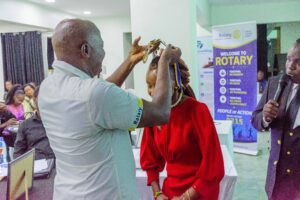
President’s chain being retrieved from Anne Munyua at the end of her tenure
I think this is something we don’t talk about enough.
What happens to a leader when the assignment is over?
What happens when the applause stops? When the photographs are taken down? When the meetings are no longer yours to chair? When people stop calling because they need your decision? When you stop hearing ‘Madam President’ to your title?
You have to learn to go.
Not because you have failed.
But because the assignment has changed.
When the show is over, you have to be willing to leave the stage.
And you better have an answer for these questions:
Where is the next place I can serve? Or where else am I serving?
There is always another assignment.
For me, that place is at CELSIR.
What Rotary Deepened in Me

Anne Munyua with the Immediate Past District Governor, Wairimu Njage at a rotary event
Perhaps this is why this Rotary year feels so deeply connected to my work at CELSIR in ways I did not fully anticipate when I began it.
I have not been living two separate leadership lives.
The work has been different, but many of the questions have been the same.
How do you build something that is bigger than yourself?
How do you create systems that survive personalities?
How do you bring people into a vision and give them enough ownership to carry it?
How do you build partnerships based on trust?
How do you remain accountable when the work becomes difficult?
And perhaps most importantly:
How do you build an institution that does not depend on one person to keep it alive?
These are questions I have wrestled with at CELSIR for the three and a half years of its service.
Our work with incarcerated people has taught me that sustainable change requires much more than good intentions. It requires systems, people, partnerships, evidence, accountability—and the courage to empower others.
Most CELSIR initiative such as the Justice From Within Prison Justice Clinic embodies that philosophy.
It begins with a simple but powerful proposition: that people who have traditionally been treated only as recipients of justice can become participants in advancing justice.
That requires trust. It requires training. It requires systems.
And it requires a willingness to share responsibility rather than hold it tightly.
Rotary has reinforced that lesson for me in an entirely different environment.
I have seen what happens when you build people rather than simply assign them tasks. When you develop leaders rather than simply look for followers. When you build systems rather than rely on memory. When you invest in partnerships rather than trying to do everything alone. And when you prepare people to take over rather than making yourself indispensable.
That last part may be the hardest because building something is one thing. Letting go of control is another. But perhaps that is where stewardship begins.
Stewardship is understanding that what has been entrusted to us is not ours to possess forever. We are custodians for a season. Our task is to strengthen what we have inherited, create what is missing, empower others, and leave behind something that can continue without us.
That is a lesson I have learned at CELSIR.
Rotary simply gave me another place to practise it.
And perhaps that is why this year has mattered to me beyond the Rotary pin, the presidential chain, the gong and gavel, goals achieved, or the projects we completed.
It has made me a more reflective, patient, and discerning leader.
And, I hope, a better steward of the institutions and people entrusted to my care.
Because ultimately, whether we are working with a Rotary Club, an organisation serving incarcerated people, a community partner, a colleague or a young person discovering their own capacity to lead, the responsibility remains the same:
Leave them stronger than you found them.
That is the kind of leadership I want to keep learning.
And that is the kind of leadership I want to keep practising.
The Day I Forgot

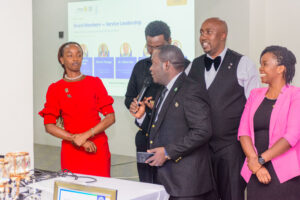
President Anne receives the presidential chain in June 2025, with Tawala looking on proudly and joyfully.
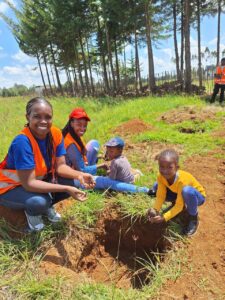
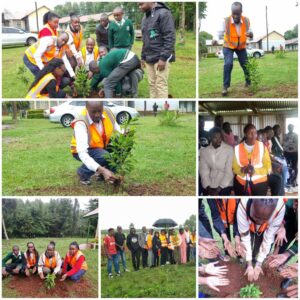
Rtns. Anne Munyua and Joy Chelangat at a tree planting session with their children
There is one moment from this year that I will probably remember longer than any project, meeting or achievement.
The day I forgot to pick up my son from school.
We had important District and Country Rotary officials visiting our club. There were things to organise, people to call, projects to visit and showcase. I was moving from one responsibility to another, completely absorbed in the demands of being the host president.
And I forgot.
When I realised, I cried.
Not because I had missed an appointment.
Because, for a moment, I had allowed the demands of service to push out someone who should never be pushed out of my world.
My son.
I hated Rotary for a brief moment.
Not because I had stopped believing in service.
Not because Rotary had done anything wrong.
I was simply angry.
Angry that, in the middle of all this service, I had forgotten my own son.
For a moment, the meetings, the projects, the calls, the people, the responsibilities—all of it felt terribly unimportant.
Then I had to do something leaders—and parents—sometimes find difficult.
I had to forgive myself.
I explained to my son what had happened.
I apologised.
And, thankfully, he forgave me.
Later, when the emotion had settled, I understood something important. Service is noble, but it must never make us forget the people we love. Leadership is not only about what we build in public; it is also about what we protect in private.
We can serve communities and still fail the people closest to us.
We can build institutions and neglect relationships.
We can be available to everyone and somehow become unavailable to the people who matter most.
That day reminded me that service must never require us to lose sight of those we love.
It also reminded me that I am human.
I will make mistakes.
I will sometimes get the balance wrong.
And when I do, I must have the courage to acknowledge it, repair what I can, forgive myself, and do better.
Perhaps that is one of the most important things Rotary gave me this year:
Not simply another opportunity to serve others, but a deeper understanding of how I want to serve without losing myself—or the people I love—along the way.
And somewhere in that lesson is Tawala’s quiet contribution to my Rotary year.
He shared his mother with Rotary.
And, on one unforgettable day, he reminded me that service begins at home too.
Grateful
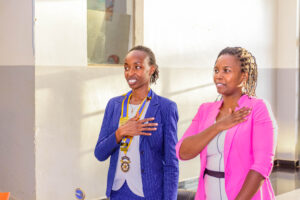
Rtns. Anne Munyua (Immediate Past President) and Joy Chelangat (Executive Secretary) of the Rotary Club of Eldoret – Uasin Gishu
I could never tell the story of this year as the story of one person.
Whatever we accomplished, we accomplished because people showed up, gave, volunteered, opened doors, travelled, challenged ideas—and believed.
But before I thank anyone else, I must thank God.
For His grace when I was tired.
For wisdom when I did not know what to do.
For strength when the responsibility felt heavy.
For the people He placed around me.
And for carrying me through a year that was, in equal measure, demanding, humbling and deeply rewarding.
To God Almighty, the Most High, be all the glory.
To every member of the Rotary Club of Eldoret–Uasin Gishu, our Rotary partners, District leadership, visiting Rotarians, friends and collaborators: thank you.
To my fellow leaders: thank you for reminding me that leadership is always a collective exercise.
To Rtn. Kimani Njoroge, I wish you wisdom, courage and joy as you take the Club forward. The role is now yours. May you make the Club stronger, kinder, more ambitious and even more committed to service.
And finally, to my son, Tawala:
Thank you for sharing your mother with the Rotary world.
You shared my evenings, my weekends, my phone calls, my meetings and, occasionally, a mother who was physically present but mentally somewhere in Rotary.
And when I got it wrong, you forgave me.
You were part of this year too.
Thank you for sharing me. ❤️
And me?
I am still here.
With another title: Immediate Past President (IPP).
The presidency has ended.
The service has not.
There is always another place where we can serve.
Onward.
Article By:
Anne Munyua
Founder & Executive Director, CELSIR