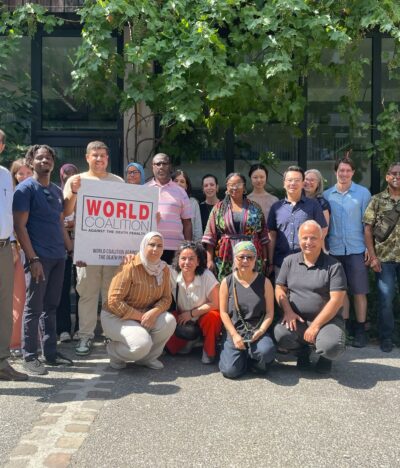

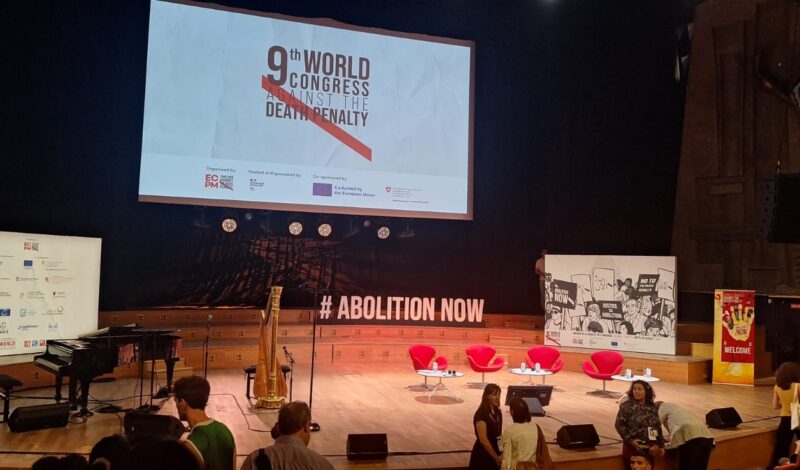

There are conferences that fill your notebook. Then there are conferences that fill your heart.
Day 2 of the 9th World Congress Against the Death Penalty in Paris was the latter.
Today’s conversations moved beyond legal doctrine and statistics. They invited us into prison cells, courtrooms, art studios, family living rooms, and the deepest corners of the human spirit. Former death row prisoners, exonerees, family members, lawyers, artists, and advocates reminded us that every discussion about capital punishment is ultimately a discussion about people.
One message echoed across every session: human dignity does not end at conviction.
Perhaps the most striking lesson was the transformative power of art.
We heard from men who discovered painting while confined to tiny death row cells, women who founded schools and choirs while awaiting execution, playwrights who used theatre to challenge public perceptions, and families who continue the work of loved ones through poetry, music, books, and social enterprises.
Art was presented not as entertainment, but as resistance.
As one speaker reflected, the executioner may destroy the body, but cannot execute a poem, silence a symphony, or erase a painting. Creativity becomes an act of survival, remembrance, and hope. It allows people to tell the world, “I was here.”
Another recurring theme was forgiveness—not as an obligation, but as liberation.
Former prisoners spoke of forgiving those who had wrongfully imprisoned them. Victims’ families spoke of rejecting vengeance without diminishing their loss. These were not stories that ignored suffering; they were stories that refused to allow suffering to have the final word.
Equally powerful was the reminder that advocacy must move beyond those who already agree with us.
One theatre director explained that reports, policy papers, and conferences are indispensable, but they often reach the same audiences. Theatre, music, photography, and storytelling reach people emotionally before they reach them intellectually. They open space for empathy where debate alone often fails.
For those of us working in criminal justice reform, this is an important challenge.
If we seek lasting change, we must speak not only to courts and policymakers, but also to communities, artists, educators, faith leaders, families, and young people. Justice reform is not simply a legal project—it is a cultural one.
The conversations also resonated deeply with developments back home in Kenya. The recent High Court decision holding that indefinite life imprisonment is incompatible with constitutional protections of dignity and freedom from inhuman treatment invites us to think beyond the binary of death or life imprisonment. If we are to build justice systems rooted in human rights, we must ensure that every sentence leaves room for humanity, accountability, rehabilitation, and hope.
As CELSIR continues to advocate for access to justice, rehabilitation, and restorative approaches to criminal justice, today’s discussions reaffirmed an enduring truth: punishment alone cannot build safer societies.
People can change.
Communities can heal.
Justice can be both accountable and compassionate.
As I left the conference venue and stepped back into the ordinary rhythm of Paris, the contrast was striking. Life continued as normal around me, but the stories I had heard travelled with me. They will continue to shape how I think about justice, rehabilitation, and the responsibility we all share in building systems that protect both public safety and human dignity.
The Congress reminded us that abolition is not simply about ending executions.
It is about affirming life.
It is about believing that every person possesses an inherent dignity that no sentence can erase.
And it is about ensuring that justice is measured not only by how we punish, but by how faithfully we preserve our shared humanity.
Article By:
Anne Munyua
Anne Munyua is Founder & Executive Director of the Center for Legal Support and Inmates’ Rehabilitation (CELSIR), a Kenya-based organization providing legal aid, strategic litigation, and rehabilitative support to persons in conflict with the law.