

Due to the moratorium, Kenya’s last execution was in 1987. Nearly four decades later, the death penalty remains on our books, and just over 100 people remain on death row, down from approximately 600 before mass commutations in 2023, by H. E. President William Rutto. Yet the death penalty remains in law, and new sentences continue to be handed down.
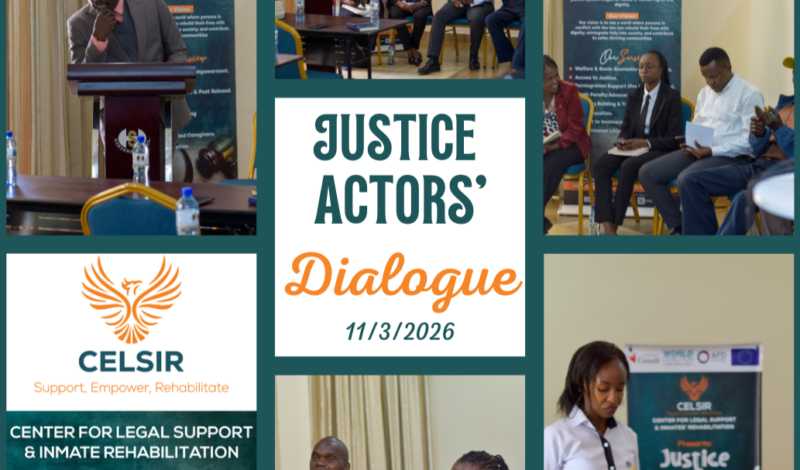
The Center for Legal Support and Inmates’ Rehabilitation – CELSIR recently convened a Justice Actors’ Dialogue to examine a simple question: What is the place of the death penalty in Kenyan society today?
The answers were complex, human, and urgent.
The Paradox of a Sleeping Giant
Our execution chamber still exists. Prison officers remain posted to oversee its “operability.” The infrastructure of death persists, even as the practice has vanished.
This creates a cruel limbo: no executions, yet no finality. Inmates on death row age into their sentences, many dying in custody of natural causes after decades of psychological torture; uncertainty, isolation, and the perpetual wait.
As one panelist noted: “We have replaced the hangman with time.”
The Human Cost
The dialogue’s most powerful testimony came from two former death row inmates who shared their experience of living 14 years and 3 years each on death row before their sentences were commuted to life in prison. Their words cut through legal abstraction:
“You die a thousand times every day…”
Their experience revealed what statistics obscure: capital punishment is not merely a sentence. It is a condition, a sustained assault on mental health, family bonds, and human dignity.
The debate is not theoretical. It involves real lives, real families, and irreversible trauma.
When the Pen Breaks: Justice Magare’s Verdict
The tension between law and conscience crystallized weeks before our dialogue, when Justice Kizito Magare of the Nyeri High Court sentenced Nicholas Macharia to death for the murder of seven-year-old Tamara Blessing Kabura, a crime the court described as premeditated and executed with “utter disregard for human life.”
Justice Magare broke his pen after delivering the sentence.
This was not theater. It is an ancient judicial tradition, traced to Mughal courts, carried through British colonial practice, symbolizing the finality and gravity of capital punishment. The broken pen signals that the instrument which wrote the ultimate sentence shall not be used again; that the court has reached the outer limit of its power; that something irreversible has occurred.
Yet here is the paradox: there is no Kenyan law requiring this gesture. Justice Magare chose it: personal, deliberate, and heavy with meaning. In a system where death sentences are routinely commuted but never abolished, the broken pen captures the moral weight of imposing what the state ultimately refuses to carry out.
Systemic Failures
Participants identified structural drivers that land people on death row:
- Poverty: Adequate legal defense remains a privilege of the wealthy
- Illiteracy: Failure to understand the legal language and processes often lands people on death row
- Legal representation gaps: Pro bono capacity is thin; capital defense specialization rarer
- Legislative stagnation: The Muruatetu decision (2016) declared mandatory death sentences unconstitutional, expanding judicial discretion. Yet Parliament has not codified resentencing frameworks, leaving courts and inmates in limbo
Justice Magare’s verdict, legally available, rarely imposed, never executed, exemplifies this dysfunction. The pen breaks. The sentence stands. The condemned waits.
Toward a Different Justice
Panelists, spanning civil society, prison paralegals, legal practitioners, local leadership, women, and community representatives, converged on a shared direction:
We must shift from punishment to rehabilitation, from isolation to reintegration, from retribution to restoration, and from perpetual uncertainty to clear sentencing frameworks.
Concrete proposals emerged:
- Accelerate parole system establishment—Kenya should embrace life-with-parole sentences
- Expand aftercare services—currently, release often means abandonment
- Strengthen alternative justice mechanisms—Victim-Offender-Mediation, plea bargaining, and diversion for appropriate cases
- Broaden the conversation—victims, clergy, law enforcement, and communities must shape reform, not just legislators
The Unasked Question
The dialogue closed where it began; with a question that answers itself:
If Kenya has functioned without executions for nearly forty years, what does that reveal about their necessity?
Four decades of de facto abolition suggests we have already, as a society, rejected the practice. What remains is the formalities: legislative courage, administrative honesty, and a justice system that matches our lived values.
Justice Magare’s broken pen asks us whether we will continue breaking instruments of death or finally break the law that demands them.
What Comes Next
CELSIR commits to:
- Advancing legislative discussions on death penalty reform
- Expanding public awareness through continued dialogue
- Strengthening reintegration systems for formerly incarcerated persons
- Documenting lived experience to inform policy
The conversation is not over. It is evolving toward a Kenya where justice restores rather than destroys.
About the Author
Anne Munyua is Founder & Executive Director of CELSIR-Africa (Centre for Legal Support and Inmate Rehabilitation), advancing access to justice, legal empowerment, and abolitionist reform in Kenya.
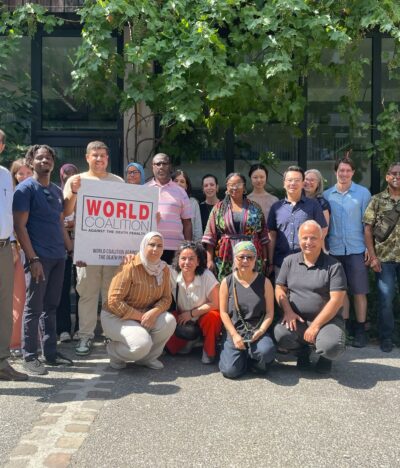
This dialogue was supported by the European Union, AFD, and Global Affairs Canada (GAC), through the World Coalition Against the Death Penalty.